

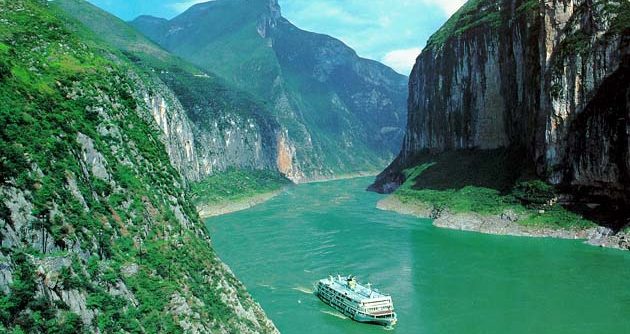
Overview:-
- The Yangtze River, known in China as the Cháng Jiāng or the Yángzǐ Jiāng, is the longest river in Asia and the third-longest in the world. The river is the longest in the world to flow entirely within one country. It drains one-fifth of the land area of the People’s Republic of China (PRC) and its river basin is home to one-third of the country’s population. The Yangtze is the sixth-largest river by discharge volume in the world.
The Yangtze River plays a large role in the history, culture and economy of China. The prosperous Yangtze River Delta generates as much as 20% of the PRC’s GDP. The Yangtze River flows through a wide array of ecosystems and is habitat to several endemic and endangered species including the Chinese alligator, the finless porpoise, the Chinese paddlefish, the (possibly extinct) Yangtze River dolphin or baiji, and the Yangtze sturgeon. For thousands of years, the river has been used for water, irrigation, sanitation, transportation, industry, boundary-marking and war. The Three Gorges Dam on the Yangtze River is the largest hydro-electric power station in the world.
- In recent years, the river has suffered from industrial pollution, agricultural run-off, siltation, and loss of wetland and lakes, which exacerbates seasonal flooding. Some sections of the river are now protected as nature reserves. A stretch of the upstream Yangtze flowing through deep gorges in western Yunnan is part of the Three Parallel Rivers of Yunnan Protected Areas, a UNESCO World Heritage Site. In mid-2014 the Chinese government announced it was building a multi-tier transport network, comprising railways, roads and airports, to create a new economic belt alongside the river.
Names
Chinese
- “Yangtze” was actually the name of Chang Jiang for the lower part from Nanjing to the river mouth at Shanghai. However, due to the fact that Christian missionaries carried out their activities mainly in this area and were familiar with the name of this part of Chang Jiang, “Yangtze river” was used to refer to the whole Chang Jiang in the English language.
Chang Jiang – “Long River”
- Chang Jiang is the modern Chinese name for the lower 2,884 km (1,792 mi) of the Yangtze from its confluence with the Min River at Yibin in Sichuan Province to the river mouth at Shanghai. Chang Jiang literally means the “Long River.” In Old Chinese, this stretch of the Yangtze was simply called Jiang/Kiang 江, a character of phono-semantic compound origin, combining the water radical 氵 with the homophone 工 (now pronounced gōng, but *kˤoŋ in Old Chinese). Krong was probably a word in the Austroasiatic language of local peoples such as the Yue. Similar to *krong in Proto-Vietnamese and krung in Mon, all meaning “river”, it is related to modern Vietnamese sông (river) and Khmer kôngkea.
- By the Han Dynasty, Jiang had come to mean any river in Chinese, and this river was distinguished as the “Great River” 大江 (Dàjiāng). The epithet 長 (of which the modern, simplified version 长), means “long”, was first formally applied to the river during the Six Dynasties period.
- Various sections of Chang Jiang have local names. From Yibin to Yichang, the river through Sichuan and Chongqing Municipality is also known as the Chuan Jiang (川江, p Chuānjiāng) or Sichuan River.
- In the Hubei Province, the river is also called the Jing Jiang or the “Jing River” after Jingzhou. In Anhui Province, the river takes on the local name Wan Jiang after the shorthand name for Anhui, wan (皖). And Yangzi Jiang t 揚子江s 扬子江, p Yángzǐjiāng) or the “Yangzi River”, from which the English name Yangtze is derived, is the local name for the Lower Yangtze in the region of Yangzhou. The name likely comes from an ancient ferry crossing called Yangzi or Yangzijin . Europeans who arrived in the Yangtze Delta region applied this local name to the Å river. The dividing sites of upstream, midstream and downstream are considered to be Yichang and Hukou (Jiujiang) respectively.
- Countries China
- Length 6,300 km (3,915 mi)
- Basin 1,808,500 km2 (698,266 sq mi)


