Overview:-
- Northern lights is a common name for the Aurora Borealis (Polar Aurorae) in the Northern Hemisphere.
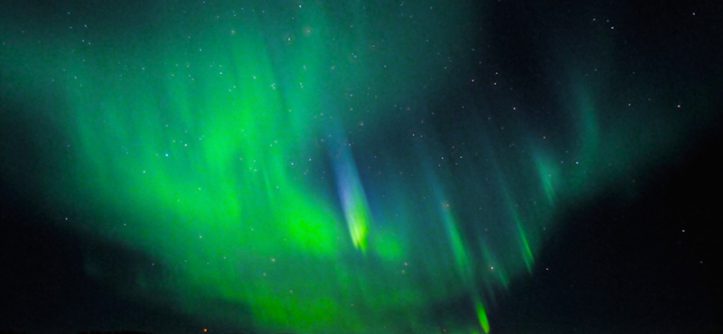
- An aurora, sometimes referred to as a polar light or northern light, is a natural light display in the sky, predominantly seen in the high latitude (Arctic and Antarctic) regions. Auroras are produced when the magnetosphere is sufficiently disturbed by the solar wind that the trajectories of charged particles in both solar wind and magnetospheric plasma, mainly in the form of electrons and protons, precipitate them into the upper atmosphere (thermosphere/exosphere), where their energy is lost.
- The resulting ionization and excitation of atmospheric constituents emits light of varying colour and complexity. The form of the aurora, occurring within bands around both polar regions, is also dependent on the amount of acceleration imparted to the precipitating particles. Precipitating protons generally produce optical emissions as incident hydrogen atoms after gaining electrons from the atmosphere. Proton auroras are usually observed at lower latitudes.
Occurrence of terrestrial auroras
- Most auroras occur in a band known as the auroral zone, which is typically 3° to 6° wide in latitude and between 10° and 20° from the geomagnetic poles at all local times (or longitudes), most clearly seen at night against a dark sky. A region that currently displays an aurora is called the auroral oval, a band displaced towards the nightside of the Earth. Early evidence for a geomagnetic connection comes from the statistics of auroral observations. Elias Loomis (1860), and later Hermann Fritz (1881) and S. Tromholt (1882) in more detail, established that the aurora appeared mainly in the auroral zone. Day-to-day positions of the auroral ovals are posted on the internet.
- In northern latitudes, the effect is known as the Aurora Borealis or the Northern Lights. The former term was coined by Galileo in 1619, from the Roman goddess of the dawn and the Greek name for the north wind. The southern counterpart, the Aurora Australis or the Southern Lights, has features that are almost identical to the Aurora Borealis and changes simultaneously with changes in the northern auroral zone. The Aurora Australis is visible from high southern latitudes in Antarctica, Chile, Argentina, New Zealand, and Australia.
- A geomagnetic storm causes the auroral ovals (north and south) to expand, and bring the aurora to lower latitudes. It was hardly ever seen near the geographic pole, which is about 2000 km away from the magnetic pole. The instantaneous distribution of auroras (“auroral oval”) is slightly different, being centered about 3–5 degrees nightward of the magnetic pole, so that auroral arcs reach furthest toward the equator when the magnetic pole in question is in between the observer and the Sun. The aurora can be seen best at this time, which is called magnetic midnight.
- Auroras seen within the auroral oval may be directly overhead, but from farther away they illuminate the poleward horizon as a greenish glow, or sometimes a faint red, as if the Sun were rising from an unusual direction. Auroras also occur poleward of the auroral zone as either diffuse patches or arcs, which can be sub-visual.
 Images
 Images
- The altitudes where auroral emissions occur were revealed by Carl Størmer and his colleagues who used cameras to triangulate more than 12,000 auroras. They discovered that most of the light is produced between 90 and 150 km above the ground, while extending at times to more than 1000 km. Images of auroras are significantly more common today than in the past due to the increase in use of digital cameras that have high enough sensitivities. Film and digital exposure to auroral displays is fraught with difficulties. Due to the different color spectrum present, and the temporal changes occurring during the exposure, the results are somewhat unpredictable. Different layers of the film emulsion respond differently to lower light levels, and choice of film can be very important. Longer exposures superimpose rapidly changing features, and often blanket the dynamic attribute of a display. Higher sensitivity creates issues with graininess.
- David Malin pioneered multiple exposure using multiple filters for astronomical photography, recombining the images in the laboratory to recreate the visual display more accurately. For scientific research, proxies are often used, such as ultra-violet, and color-correction to simulate the appearance to humans. Predictive techniques are also used, to indicate the extent of the display, a highly useful tool for aurora hunters. Terrestrial features often find their way into aurora images, making them more accessible and more likely to be published by major websites. It is possible to take excellent images with standard film (using ISO ratings between 100 and 400) and a single-lens reflex camera with full aperture, a fast lens (f1.4 50 mm, for example), and exposures between 10 and 30 seconds, depending on the aurora’s brightness.