

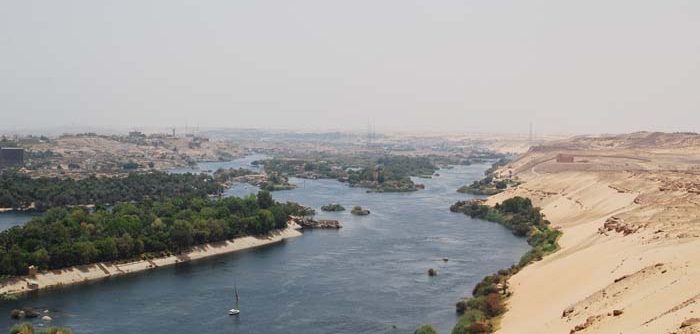
Overview:-
- The Nile Ancient Egyptian: Ḥ’pī and Iteru; Biblical Hebrew: יאור, Ye’or) is a major north-flowing river in northeastern Africa. It is generally regarded as the longest river in the world, however other conflicting sources cite a 2007 study that gave the title to the Amazon River in South America. The Nile, which is 6,853 km (4,258 miles) long, is an “international” river as its water resources are shared by elevencountries, namely, Tanzania, Uganda, Rwanda, Burundi, Congo-Kinshasa, Kenya, Ethiopia, Eritrea, South Sudan, Sudan and Egypt. Inparticular, the Nile is the primary water source of Egypt and Sudan.
- The Nile has two major tributaries, the White Nile and Blue Nile. The White Nile is considered to be the headwaters and primary stream of the Nile itself.
- The Blue Nile, however, is the source of most of the water and silt. The White Nile is longer and rises in the Great Lakes region of central Africa, with the most distant source still undetermined but located in either Rwanda or Burundi. It flows north through Tanzania, Lake Victoria, Uganda and South Sudan. The Blue Nile begins at Lake Tana in Ethiopia and flows into Sudan from the southeast. The two rivers meet just north of the Sudanese capital of Khartoum.
- The northern section of the river flows north almost entirely through the Sudanese desert to Egypt, then ends in a large delta and empties into the Mediterranean Sea. Egyptian civilization and Sudanese kingdoms have depended on the river since ancient times. Most of the population and cities of Egypt lie along those parts of the Nile valley north of Aswan, and nearly all the cultural and historical sites of Ancient Egypt are found along riverbanks.
- In the ancient Egyptian language, the Nile is called Ḥ’pī or Iteru (Hapy), meaning “river”. In Coptic, the words piaro (Sahidic) or phiaro (Bohairic) meaning “the river” come from the same ancient name.
- The English name Nile and the Arabic names en-Nîl and an-Nîl both derive from the Latin Nilus and the Ancient Greek Νεῖλος. Beyond that, however, the etymology is disputed. One possible etymology derives it from a Semitic Nahal, meaning “river”. The standard English names”White Nile” and “Blue Nile”, to refer to the river’s source, derive from Arabic names formerly applied only to the Sudanese stretches which meet at Khartoum.
Course
- Above Khartoum, the Nile is also known as the White Nile, a term also used in a limited sense to describe the section between Lake No and Khartoum. At Khartoum the river is joined by the Blue Nile. The White Nile starts in equatorial East Africa, and the Blue Nile begins inEthiopia. Both branches are on the western flanks of the East African Rift.
- The drainage basin of the Nile covers 3,254,555 square kilometers (1,256,591 sq mi), about 10% of the area of Africa. The Nile basin is complex, and because of this, the discharge at any given point along the mainstem depends on many factors including weather, diversions, evaporation and evapotranspiration, and groundwater flow.
Sources
- The source of the Nile is sometimes considered to be Lake Victoria, but the lake has feeder rivers of considerable size. The Kagera River, which flows into Lake Victoria near the Tanzanian town of Bukoba, is the longest feeder, although sources do not agree on which is the longest tributary of the Kagera and hence the most distant source of the Nile itself. It is either the Ruvyironza, which emerges in BururiProvince, Burundi, or the Nyabarongo, which flows from Nyungwe Forest in Rwanda. The two feeder rivers meet near Rusumo Falls on the Rwanda-Tanzania border.The source of Nile from the underwater spring at the neck of Lake Victoria, Jinja.
- In 2010, an exploration party went to a place described as the source of the Rukarara tributary, and by hacking a path up steep jungle-choked mountain slopes in the Nyungwe forest found (in the dry season) an appreciable incoming surface flow for many kilometres upstream, and found a new source, giving the Nile a length of 6,758 km (4,199 mi).
- Gish Abay is reportedly the place where the “holy water” of the first drops of the Blue Nile develop.
• Countries Ethiopia, Sudan, Egypt, Uganda, Congo-Kinshasa, Kenya, Tanzania,Rwanda, Burundi, South Sudan, Eritrea
• Length 6,853 km (4,258 mi)
• Width 2.8 km (2 mi)
• Basin 3,400,000 km2 (1,312,747 sq mi)
• Discharge – average 2,830 m3/s (99,941 cu ft/s)


