

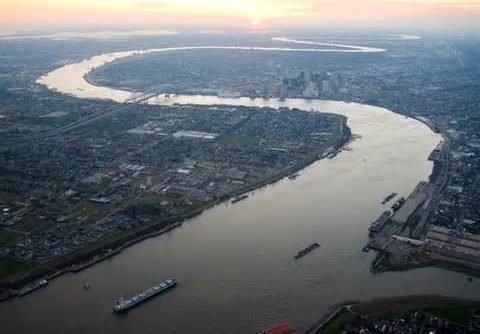
Overview:-
- The Mississippi River is the chief river of the largest drainage system on the North American continent. Flowing entirely in the United States (although its drainage basin reaches into Canada), it rises in northern Minnesota and meanders slowly southwards for 2,320 miles (3,730 km) to the Mississippi River Delta at the Gulf of Mexico. With its many tributaries, the Mississippi’s watershed drains all or parts of 31 U.S. states and 2 Canadian provinces between the Rocky and Appalachian Mountains. The Mississippi ranks as the fourth longest and fifteenth largest river in the world by discharge. The river either borders or passes through the states of Minnesota, Wisconsin, Iowa, Illinois, Missouri, Kentucky, Tennessee, Arkansas, Mississippi, and Louisiana.
- Native Americans long lived along the Mississippi River and its tributaries. Most were hunter-gatherers, but some, such as the Mound Builders, formed prolific agricultural societies. The arrival of Europeans in the 16th century changed the native way of life as first explorers, then settlers, ventured into the basin in increasing numbers. The river served first as a barrier, forming borders for New Spain, New France, and the early United States, and then as a vital transportation artery and communications link. In the 19th century, during the height of the ideology of manifest destiny, the Mississippi and several western tributaries, most notably the Missouri, formed pathways for the western expansion of the United States.
- Formed from thick layers of the river’s silt deposits, the Mississippi embayment is one of the most fertile agricultural regions of the country, which resulted in the river’s storied steamboat era. During the American Civil War, the Mississippi’s capture by Union forces marked a turning point towards victory due to the river’s importance as a route of trade and travel, not least to the Confederacy. Because of substantial growth of cities and the larger ships and barges that supplanted riverboats, the first decades of the 20th century saw the construction of massive engineering works such as levees, locks and dams, often built in combination.
- Since modern development of the basin began, the Mississippi has also seen its share of pollution and environmental problems – most notably large volumes of agricultural runoff, which has led to the Gulf of Mexico dead zone off the Delta. In recent years, the river has shown a steady shift towards the Atchafalaya River channel in the Delta; a course change would be an economic disaster for the port city of New Orleans.
Name
- The word itself comes from Messipi, the French rendering of the Anishinaabe (Ojibwe or Algonquin) name for the river, Misi-ziibi (Great River). See below in the History section for additional information.
- In addition to historical traditions shown by names, there are at least two other measures of a river’s identity, one being the largest branch (by water volume), and the other being the longest branch. Using the largest-branch criterion, the Ohio (not the Middle and Upper Mississippi) would be the main branch of the Lower Mississippi. Using the longest-branch criterion, the Middle Mississippi-Missouri-Jefferson-Beaverhead-Red Rock-Hellroaring Creek River would be the main branch. According to either school of thought, the Upper Mississippi from Lake Itasca, Minnesota, to St. Louis, despite its name, would only be a secondary tributary of the final river flowing from Cairo, Illinois, to the Gulf of Mexico.
- While the Missouri River, flowing from the confluence of the Jefferson, Madison, and Gallatin Rivers to the Mississippi, is the longest continuously named river in the United States, the serially named river known sequentially as Hellroaring Creek, Red Rock, Beaverhead, Jefferson, Missouri, Middle Mississippi, and Lower Mississippi, considered as one continuous waterway, is the longest river in North America and the fourth longest river in the world. Its length of at least 3,745 mi (6,027 km) is exceeded only by the Nile, the Amazon, and perhaps the Yangtze River among the longest rivers in the world. The source of this waterway is at Brower’s Spring, 8,800 feet (2,700 m) above sea level in southwestern Montana, along the Continental Divide outside Yellowstone National Park.
- In the 18th century, the river was the primary western boundary of the young United States, and since the country’s expansion westward, the Mississippi River has been widely considered a convenient if approximate dividing line between the Eastern, Southern, and Midwestern United States, and the Western United States. This is exemplified by the Gateway Arch in St. Louis and the phrase “Trans-Mississippi” as used in the name of the Trans-Mississippi Exposition. It is common to qualify a regionally superlative landmark in relation to it, such as “the highest peak east of the Mississippi or “the oldest city west of the Mississippi.
- Countries United States
- Length 2,320 mi (3,734 km)
- Basin 1,151,000 sq mi (2,981,076 km2)


